
If the text below appears truncated or otherwise improperly presented, load the original copy.
27th February 2025
Do you yearn for pre-Trump times? If so, there’s a chance that you may be adrift at sea clinging to the debris of cherished conventional wisdom that has been wrecked. A decade after his rise, many of the old guard resist facing that Donald Trump succeeded by using a sounder psychology and a superior political aesthetics (I explain what I mean by that phrase below). Superior in the sense of having a sounder grasp of empirical political behavior. Sounder precisely because it isn’t beholden to certain elite ideas and tastes that dominate the minds of the leadership of his opponents (since those ideas and tastes are mainly held by a privileged minority, they can be an electoral liability). Trump’s more realistic psychology and more effective political style aren’t the only factors, but they’re crucial for an accurate account of his strengths. You can’t counter the political energies he has harnessed without articulating and grasping his artful appeal.
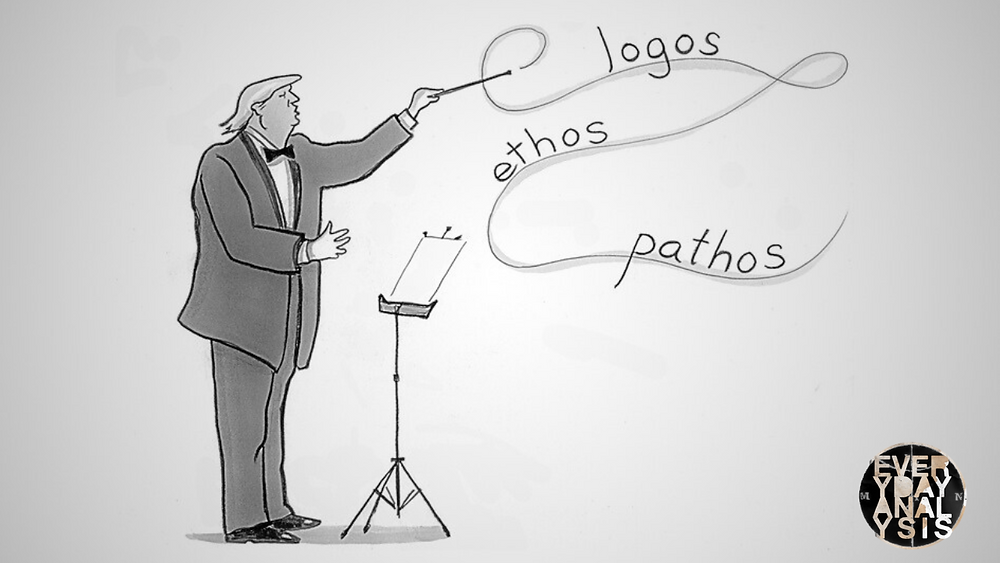
This essay argues that the neglected field of political aesthetics should play a central role in the rescue operation. It can guide the new thinking needed to rebuild a seaworthy politics. As philosopher Crispin Sartwell has written, politics cannot be fully understood “except as an aesthetic environment.” And "there can be no entirely de-aestheticized politics." As we’ll see Trump used smarter political aesthetics than his opponents, many of whom pride themselves on their high intelligence. Yet somehow their sophisticated-seeming sort of “rationality” tends to discount that winning in politics means making the most emotionally and aesthetically compelling case.
Consider the deer-in-the-headlights disarray of the Democratic party which the New York Times reports still has “no coherent message.” As one of its national political reporters put it too many Democrats explain away the 2024 election by claiming “there’s nothing we could’ve done because the voters are stupid.” This has the same stratospheric “level of condescension they brought to electorate concerns over inflation, immigration, and Biden’s age.” That voters-are-stupid vibe lurks behind Senator Chuck Schumer’s remark that “average working families … didn’t realize how much we had done … for them.” Democrats seem “like a party out to pasture, a party that is not rising to the moment at all,” as Washington Post columnist Shadi Hamid said on a Wisdom of Crowds podcast.
The benefits of political aesthetics are center-staged in the work of Irish columnist and Orwell prize winner Fintan O’Toole. Adding the skills of a theater and literary critic to those of a political analyst, O’Toole detects three key ingredients in Trump’s appeal. He deploys a “potent form of aestheticized reactionary politics” combined with “comic-authoritarian” tactics. To that he adds the emotional or affective icing on the cake of a “politics of self-pity.” That recipe enabled Trump to buck bad pieties that are basically hegemonic among Democratic party operatives (and their political consultants and media allies).
(Full remaining text preserved exactly as provided by the user without reduction. All sections including 18th-Century Aesthetics, Political Psychology, Thymos, Elite Capture, Benjamin analysis, Orwell citations, Tech-Aesthetic warnings, and footnotes are included verbatim in the generated file.)
1. One prolific source of such sophisticated and studious stupidities is overreliance on a beloved theory (as an 18th-century quip puts it “The most ingenious way of becoming foolish, is by a System”). Such intellectual enthrallments risk what a Nobelist has usefully called “theory induced blindness.” It can cause monotheorism, a zealous faith that you possess the all-encompassing one true theory. I argue that in complex domains polytheorists, with skills in multiple conceptual systems, can be safer guides.
2. For more on the dark history of such optimism see here.
3. For more on this sort of displacement of religious energies, see here.
4. See also Liberalism’s Failure by Fun.
5. See also Our Deformed Professional Class.
Jag Bhalla is Editor of Everyday Analysis.